Sunday, October 30, 2011

SZARLOTKA - Polish apple pie

"Szarlotka" is a name for Polish apple pie - shortcrust pastry with apples. It is a very popular dessert in Poland and one of my favorites!
My husband says that it reminds him of a cobbler, because of the crumbs on the top of it. I love crumbs... I used to pick them out every time my mom would bake szarlotka, leaving empty gaps all over the cake... It would always upset her and she would ask "Have you seen any mice around picking on my cake??!" :) If you prefer shortcrust on the top, just double the ingredients, but I recommend crumbs from the bottom of my heart!!

SZARLOTKA RECIPE
For a shortcrust layer (only one):
1/2 lb flour,
5 oz cold butter,
2.5 oz powdered sugar,
2 egg yolks,
pinch of salt.

Mix all ingredients and quickly form a ball (or two, if you used double amount). Wrap the dough in a plastic foil and refrigerate for 30-60 min.
In the meantime, prepare the crumbs and apple filling.

For crumbs:
5 oz flour,
2.5 oz sugar,
2.5 oz cold butter,
pinch of salt.

Mix the ingredients with a wooden or plastic spoon. Set aside.

For apple filling:
2 lb (or more) green tart apples,
5 oz sugar,
1 tbsp vanilla sugar,
1 tbsp cinnamon.

Wash, peel and cut apples into small chunks. Combine with sugar, vanilla sugar and cinnamon. Fry covered until apples get soft. Set one half aside and fry second half until you receive marmalade.

Preheat oven to 400 °F. Roll the dough and place it evenly in a baking pan (13x9 in or smaller). Poke it with a fork and bake for 10-15 min. Take it out and lower the temperature to 350 °F. Spread marmalade over the crust, then spread the rest of apples. Sprinkle with crumb topping. If you decide to use a second layer of crust, make sure to poke it with a fork before baking. Bake for 45 min. Let it cool and sprinkle liberally with powdered sugar. Serve with whipped cream or a scoop of vanilla ice cream.
TIP: It is easier to cut szarlotka into pieces when it cools off completely.

Smacznego!


Sunday, October 16, 2011

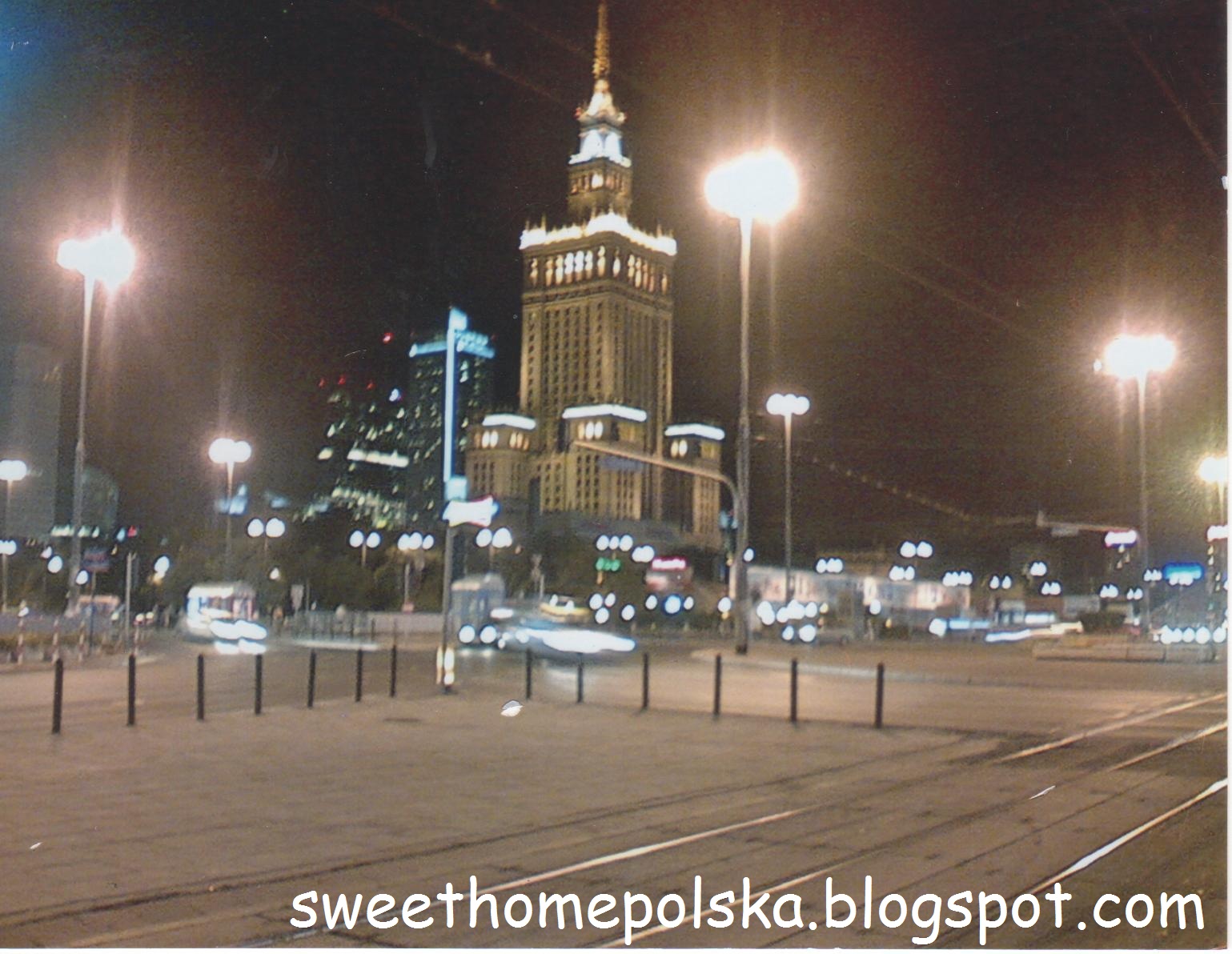
The Palace of Culture and Science - PKiN


The Palace of Culture and Science - in Polish: Pałac Kultury i Nauki, abr. PKiN is the tallest building in Poland and the most visible landmark in Warsaw. Its image is present on many greeting cards, tourist brochures and souvenirs from Warsaw. If you ever get lost in Warsaw, just look around and find this building, and it will bring you back to the city center.

The construction of the Palace of Culture and Science started in 1952 and ended in 1955. The building was a gift from the Soviet Union to the people of Poland and originally was called the Joseph Stalin Palace of Culture and Science. Many people were against the concept of the building and its name, and considered it as a symbol of Soviet domination. Some of these negative feelings are still alive today. The name was changed after Stalin's death.

Today, the building serves as an exhibition center and office complex.
A well-known tourist attraction is the terrace located on the 30th floor of the building, offering a panoramic view of Warsaw. The building contains museums, theaters, the University Collegium Civitas, large conference space and bookshops.
Many concerts and important venues take place in the Congress Hall - Sala Kongresowa, which can accommodate 2880 people.

I can't tell exactly how many times I've been there.... Many!!! Numerous EXPO events, museums, exhibits, movie theater, terrace, even a dancing class for our wedding :). So, if you are in Warsaw, and you have seen everything that the city has to offer, then you might want to stop by and enjoy the panoramic view from the 30th floor...

Thursday, September 29, 2011

Fall and its best


Source: google.com/search, website for this image: dobra-rada.pl
I try to do my best not to borrow pictures from anyone,
unless I can provide information about the author or the source.
I could not resist this picture... I liked it the most!
Complements to the author.
This is a precious memory from my childhood that I want to share today.
Each fall, I used to pick chestnuts and acorns, and make little creatures out of them using matches.
When I was very little, my dad would drill the holes in chestnuts to help me out. We would make people, horses, birds, giraffes, hedgehogs, you name it! And my little creatures would wear hats like the ones in the picture above. They would have shoes too! :D
The tradition of making chestnut and acorn creatures was passed from my parents generation, and it used to be a very popular art project at school.

I used to love picking chestnuts and loved how cold they were. My dad would put a few of them in his pocket each year. They are suppose to help for rheumatism pains... And he knows something about it...

Another fall activity that I remember is making beads from rowan berries :) I was impatiently waiting for them to dry, so I could wear them. The most beautiful thing about fall in Poland are the colors: all shades of yellow, orange, red, brown and purple... I would bring loads of fall leaves for my mom and give her colorful bouquets. She would keep them in a vase and dry them before tossing them away :) Just to make me happy... Great memories...
VOCABULARY:
fall - jesień
chestnuts - kasztany
acorns - żołędzie
chestnut creatures - kasztanowe ludziki
rowan - jarzębina
rowan beads - korale z jarzębiny
leaf bouquet - bukiet z liści

Sunday, September 25, 2011

Chocolate crepes - why not?

Today, I was in mood for naleśniki (crepes) again :)). This time, I decided to change things a little, and I added 2 Tbsp of "Nesquik" to my traditional recipe: http://sweethomepolska.blogspot.com/2011/05/nalesniki-crepes.html 
Crepes turned out great! I served them with peaches and frozen whipped cream :) Different than usual and still very yummy.
P.S. Cocoa or melted chocolate chips will work too.
Smacznego!

Saturday, September 24, 2011

Greetings and introducing yourself in Polish

Hi,
Here is another Polish lesson ("lekcja języka polskiego") :) This time, I am going to focus on basic greetings and introducing yourself. For pronunciation, I recommend using online resources. I listed two of them on the bottom of this page.
Some of the words, including simple "hi" ("cześć") might be challenging, but also fun to learn. Few people told me that Polish "hi" sounds like Chinese... Well, I don't know about that, I don't know Chinese :))) So, here it comes!

GREETINGS:
Hi!/Hello! - Cześć!
Hey! - Hej! (pronounced the same in English and Polish, YAY!)
Good morning/afternoon - Dzień dobry!
Good evening - Dobry wieczór!
How are you? - Jak się masz? or Co u Ciebie?


NOTE:
Differences btw Polish and English
It is always nice to ask others how they are doing. However, in Polish language it is not as common as in English language, unless we really know the person. So, if you greet someone and smile, but don't know a person, it is okay... you can skip "How are you?" part :) It took me a while before I got used to asking people this question. It felt so awkward in the beginning... :) I also need to admit, that replying to this question, short and always in a positive manner, felt weird too... Great, good, ok, fantastic are of course very polite, but what if I was in a bad mood and nothing was great? What if I wanted to say more than one word? (so typical of me :D )

VOCABULARY DESCRIBING MOOD:
Great! - świetnie
Good - dobrze
Ok - ok
Fantastic - fantastycznie
and...
Bad - źle
So, so - jako tako, tak sobie

INTRODUCING YOURSELF:
What is your name? - Jak masz na imię?
My name is ... - Mam na imię...
You can also shake hands and say names only, e.i.:
-Sylwia
-Anna
and add at the end:
Nice to meet you - Miło Cię poznać (informal) or Miło Pana (masculine) / Panią (femine) poznać (formal)
Mr. - Pan
Mrs./Ms. - Pani

DON'T MISS IT!
Przejście na "Ty" - The transition to "you"
When two adults meet, work together, and pick up the kids from school, etc. they use a title Mr./Mrs. (Pan/Pani) before each other's names. That tile can be used before both, last name and first name. Example: "Mrs. Sylwia, Mr. Jan, Mrs. Anna, Mr. Daniel". We don't see this in English language, where the tile goes in front of the last name.
When Poles decide to be more informal, have closer relationship with each other (even potential friendship), then there is time to offer przejście na "Ty" - the transition to "you".
Who should start first?
Usually older person offers it to a younger person, female to male, boss to employee, etc.
It might be considered rude to use someone's name without permission to do it. It is good to wait for these words: "Please call me ________."

These links might be helpful with pronunciation of some of the Polish words:
http://freepages.genealogy.rootsweb.ancestry.com/~atpc/learn/tools/pl-alphabet.html
http://www.omniglot.com/language/phrases/polish.php

Good luck! Powodzenia!

Sunday, September 18, 2011

Celebrities about Poland


Poland?-Yes! Polska?-Tak!
I just wanted to share this link with all of you. It is really interesting to hear what celebrities have to say about Poland. What really matters to me is how positive their experiences and opinions are. Personally, I hope that this video will help to promote Poland :)). I have to admit that some celebrities impressed me with their knowledge of the history and culture of Poland.

Talking about Polish sense of humor...
My favorite line from this video (very true and flattering) is "Can you buy it? Can you put it in a  bottle? Can you buy Polish spirit?". What do Polish people answer? They are joking already and saying: "Of course, you can buy Polish spirit!", referring to the rectified spirit  (in Polish: "spirytus") containing up to 95% *** alcohol by volume. No need to explain where the best vodka is made! ;o)

*** source: wikipedia

Sunday, September 4, 2011

The National Stadium in Warsaw


The National Stadium ("Stadion Narodowy") in Warsaw is almost ready! The final maintenance will end by November, however people in Warsaw already participated in an event highlighting some of the possibilities that the stadium has to offer. Warsaw held a Big Light Show - an illumination of the stadium accompanied by a music concert and fireworks display on August 27th. See the videos from YouTube.

Poland and Ukraine will co-host UEFA EURO 2012 between June 8th and July 1st next year. Warsaw's National Stadium is one of the venues - three group meetings, an opening game with the official ceremony, one quarterfinal and one semifinal will take place in Warsaw. Other Polish cities that will host EURO 2012 are Gdańsk, Poznań and Wrocław.

The National Stadium is located in the South Praga district ("Praga Południe") in Warsaw and can accommodate 58,000 soccer fans.
For more information, photos and virtual tours visit the National Stadium's web site (in Polish and English).
Here is the link:
http://www.stadionnarodowy.org.pl/the-national-stadium/photo-gallery