Wednesday, November 30, 2011

Amber - Gold of the Baltic Sea

Amber (in Polish: "bursztyn") is a popular souvenir from Poland and makes the best gift ever!
Polish amber is unique and known all over the world. It comes in different colors: orange, brown, green and white. Bursztyn can be found all over the south coast of the Baltic Sea.
Fall and spring storms are the best time for amber collectors who take walks on the beach after the storm, looking for a "gold of the Baltic Sea". One of the popular methods is searching the beach at night by using flashlights. The light helps to spot amber that shines under the water and can be seen from a long distance.

Polish name bursztyn comes from German "bernstein" which means "burning stone". Burning amber produces an intensive aroma, and even Egyptian queen Cleopatra used it as an incense :)

The Baltic amber is a harden resin which originated 40 million years ago. The resin was produced most likely by pine trees which were located in the region where the Baltic Sea is today. This explains why there is lots of amber with insects in it. The resin became hard under cold water temperatures.

Polish legend
Our great grandfathers believed that there was a gold, amber palace on the bottom of the Baltic Sea, that belonged to the beautiful princess Jurata. She felt very lonely in her palace, and one day took a trip to the coast where she met a poor and handsome fisherman. Jurata fell in love with him. When the king of the Baltic Sea found out about it, he got very upset, threw lightning on the fisherman's boat and killed him. Seeing princess Jurata crying, the king threw another lightning on the amber palace and killed her. The amber palace broke into a million pieces. The storms would throw gold amber onto the beach to remind us of the tragic love and the anger of the king.

Natural medicine and amber
Amber has been also used in the natural medicine. It creates "friendly" negative ions and brings balance into our stressful life. Amber liquor is known for being a remedy for almost anything - flu, fever, migraines, stomachaches, heartaches, rheumatic pains, asthma, bronchitis and more... (yes, more!)
My favorite bracelet with amber
Amber jewelry makes a great gift and I am a huge fan of it myself. Besides jewelry, there many other souvenirs made of amber that are sold in the galleries, jewelry shops and gift shops across the country.
Some items might be pricey, but once you fall for amber your love will never end!


Tuesday, November 15, 2011

Charlotte Dessert - little experiment

Simplicity...
Today was supposed to be quick and easy.  I already introduced a recipe for Polish apple pie called "Szarlotka". Cold and super windy days like the one today make apples with cinnamon sound really good. Here is a simple alternative for "Szarlotka": Charlotte Dessert.

I read about it while making "Szarlotka" a few weeks ago. Charlotte used to be a very popular dessert in Old-Polish, Austrian and French cuisine. It is nothing else, even the name sounds so sophisticated, but a warm, apple dessert baked in a casserole dish or in ramekins.
(Santa, please send some ramekins my way! I have been good and have been learning how to cook! :))))

The baking dish should be lined with bread crumbs, cake pieces or sponge fingers. I used vanilla wafers, but I didn't crush them (Mistake # 1). Also, in my speedy mood, I didn't cook apples long enough (Mistake # 2), so my Charlotte Dessert didn't turn out to be a complete success. But hey, it was still delicious! Apples are apples and you can't go wrong with them:)) I must have forgotten that I owe the lids! A lid over a pan will do the job:)) Many recipes for Charlotte call for addition of apricot jelly. I believe, that perfect consistency of this dessert would be soft and jelly-like.
I did it MY WAY again and it was worth it anyways!


Recipe:
4 peeled tart apples,
2 Tbsp sugar,
1 Tbsp butter,
2 Tbsp craisins (my own addition),
2 Tbsp raisins,
cinnamon,
crushed vanilla wafers or whole size sponge fingers.
**** Additional ingredients that I didn't have:
4-5 Tbsp apricot jelly,
some rum.
  1. Wash and peel apples. Cut them into small chunks and cook covered with sugar, cinnamon and butter until soft. Stir once in a while and make sure that they do not turn into a marmalade:)
  2. Add raisins and craisins if desired. * If you have apricot jelly mix it in, too. Don't cook.
  3. Crush wafers and mix them with melted butter (2 Tbsp) or, if using sponge fingers, soak them in some rum. Line bottom and sides of baking pan (6 x 8.5 in) with crumbs/sponge fingers.
  4. Spread apple mixture over the cookies and bake at 350 ºF for 30 min.

Serve warm with whipped cream, ice cream or vanilla sauce.
Smacznego!

Ps. With Holiday Season around the corner, this was my last recipe with apples. I promise:)

Monday, November 14, 2011

Nov. 11th - National Independence Day

National Independence Day - "Narodowe Święto Niepodległości" falls on November 11th and is a public holiday in Poland. Main celebration of this anniversary takes place in Józef Piłsudski Square in Warsaw.
Looking at very rich history of Poland, it is certain that strong patriotism of its people was essential to keep this country alive. Poland disappeared from a map for 123 years (!!!) and was torn apart between Russia, Prussia and Austria. After three partitions and long lasting occupation, Poland regained its independence in 1918.

Thursday, November 10, 2011

Imieniny - Namedays

What a perfect month to write about Namedays (in Polish: Imieniny)!  My nameday falls in November! :)) A nameday is the day of the year associated with one's given name. The tradition of celebrating namedays is popular in European and Latin American countries.

In Poland, namedays are almost as important as birthdays. People gather and socialize with family and friends, receive wishes, flowers and gifts. Small bouquet of flowers or box of chocolates is always a very nice gesture and is welcomed.

There a few ways to remember about someone's nameday:
  • First of all, almost every calendar has a list of the names which are celebrated on a particular day. Sometimes one's given name might be listed in the calendar even couple times a year! What do we do then? :) The most common rule is to celebrate your nameday on the nearest occasion after your birthday. 
  • Many web sites list the names on the top of their home page daily.
  • Buses :)) Yes, you can read who celebrates a nameday while riding the bus to work or school :))
  • Radio stations. Names are usually announced in the morning after the news and weather forecasts.
So, no excuses! A nameday is another day to celebrate and socialize.
I honestly miss this tradition here in the US. Close family and friends send wishes to me and it means the world to me.

Tuesday, November 1, 2011

Halloween vs All Saints' Day

All Saints' Day
In Poland November 1st is known as All Saints' Day (Dzień Wszystkich Świętych). Overall, it is a sad and full of reflection day honoring those who passed away... Many people travel across the country to visit cemeteries where their family members are buried. They light the candles on the graves and pray for the souls that are being missed.
Halloween
Halloween (All Hallows' Eve/All Saints' Eve) came to Poland in late 90's and is mainly celebrated in night clubs, bars and at home parties. Many people dress up for fun. It is not popular to go trick-or-treat'ing though.
At my home, the idea of Halloween party would be considered as "a little too much fun" just a night before All Saints' Day, however my parents didn't stop me, if I wanted to attend one of the Halloween dances... Personally, I think that both events can be celebrated separately.
Own source: My first carved pumpkin - the one on the left

Things that I like about Halloween:
- carving pumpkins,
- kids and adults wearing nice (read: friendly) costumes,
- trick or treat'ing (excuse to have some candy! why not?).

Things that I don't like about Halloween:
- gross costumes and decorations,
- creepy music,
- food such as eye balls, fingers, teeth, etc.
- haunted houses.
Mercy! Anything gross does not speak to me!  :))

Sunday, October 30, 2011

SZARLOTKA - Polish apple pie

"Szarlotka" is a name for Polish apple pie - shortcrust pastry with apples. It is a very popular dessert in Poland and one of my favorites!
My husband says that it reminds him of a cobbler, because of the crumbs on the top of it. I love crumbs... I used to pick them out every time my mom would bake szarlotka, leaving empty gaps all over the cake... It would always upset her and she would ask "Have you seen any mice around picking on my cake??!" :) If you prefer shortcrust on the top, just double the ingredients, but I recommend crumbs from the bottom of my heart!!

SZARLOTKA RECIPE
For a shortcrust layer (only one):
1/2 lb flour,
5 oz cold butter,
2.5 oz powdered sugar,
2 egg yolks,
pinch of salt.

Mix all ingredients and quickly form a ball (or two, if you used double amount). Wrap the dough in a plastic foil and refrigerate for 30-60 min.
In the meantime, prepare the crumbs and apple filling.

For crumbs:
5 oz flour,
2.5 oz sugar,
2.5 oz cold butter,
pinch of salt.

Mix the ingredients with a wooden or plastic spoon. Set aside.

For apple filling:
2 lb (or more) green tart apples,
5 oz sugar,
1 tbsp vanilla sugar,
1 tbsp cinnamon.

Wash, peel and cut apples into small chunks. Combine with sugar, vanilla sugar and cinnamon. Fry covered until apples get soft. Set one half aside and fry second half until you receive marmalade.

Preheat oven to 400 °F. Roll the dough and place it evenly in a baking pan (13x9 in or smaller). Poke it with a fork and bake for 10-15 min. Take it out and lower the temperature to 350 °F. Spread marmalade over the crust, then spread the rest of apples. Sprinkle with crumb topping. If you decide to use a second layer of crust, make sure to poke it with a fork before baking. Bake for 45 min. Let it cool and sprinkle liberally with powdered sugar. Serve with whipped cream or a scoop of vanilla ice cream.
TIP: It is easier to cut szarlotka into pieces when it cools off completely.

Smacznego!


Sunday, October 16, 2011

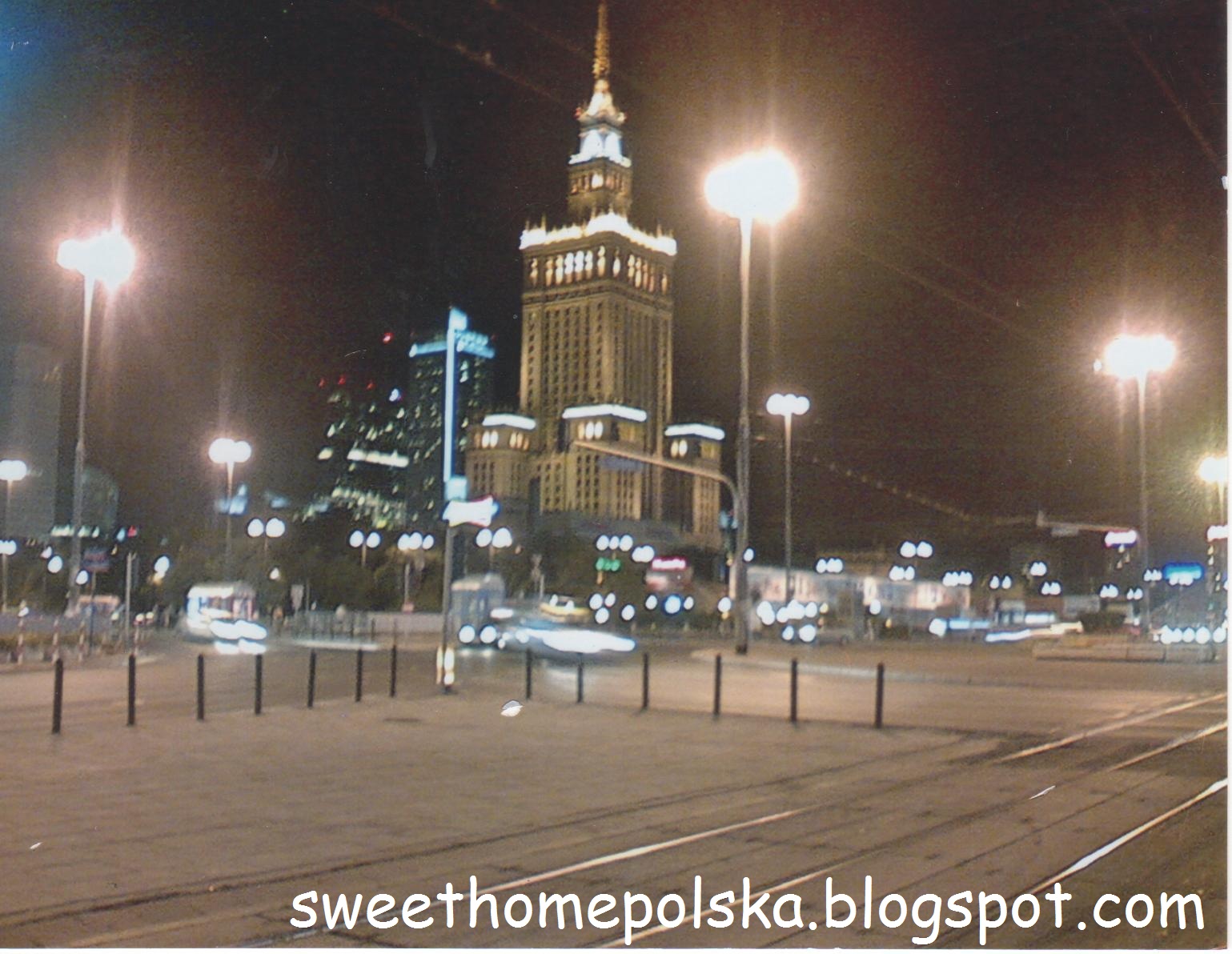
The Palace of Culture and Science - PKiN


The Palace of Culture and Science - in Polish: Pałac Kultury i Nauki, abr. PKiN is the tallest building in Poland and the most visible landmark in Warsaw. Its image is present on many greeting cards, tourist brochures and souvenirs from Warsaw. If you ever get lost in Warsaw, just look around and find this building, and it will bring you back to the city center.

The construction of the Palace of Culture and Science started in 1952 and ended in 1955. The building was a gift from the Soviet Union to the people of Poland and originally was called the Joseph Stalin Palace of Culture and Science. Many people were against the concept of the building and its name, and considered it as a symbol of Soviet domination. Some of these negative feelings are still alive today. The name was changed after Stalin's death.

Today, the building serves as an exhibition center and office complex.
A well-known tourist attraction is the terrace located on the 30th floor of the building, offering a panoramic view of Warsaw. The building contains museums, theaters, the University Collegium Civitas, large conference space and bookshops.
Many concerts and important venues take place in the Congress Hall - Sala Kongresowa, which can accommodate 2880 people.

I can't tell exactly how many times I've been there.... Many!!! Numerous EXPO events, museums, exhibits, movie theater, terrace, even a dancing class for our wedding :). So, if you are in Warsaw, and you have seen everything that the city has to offer, then you might want to stop by and enjoy the panoramic view from the 30th floor...